
Lansing’s local history collection, a priceless trove of artifacts and documents assembled over a period of nearly 150 years, vanished earlier this year from the central downtown location where it had been housed since 1969. Virtually without public consultation, with barely a modicum of notice, Capital Area District Libraries or CADL pronounced like Cattle with a “D” whisked it away to a remote office park off the side of an expressway ten miles east in Okemos, a wealthy census-designated place separated from the City of Lansing by two municipal borders and an ocean of privilege.1 Essentially inaccessible by foot or bicycle and well over an hour from downtown Lansing by public transit, the new CADL Local History Center, which opened on May 19th, can be found in a glorified serpentine parking lot some developer has dubbed University Park Drive, notwithstanding the absence of any universities or parks for miles in any direction. I like to imagine the moniker as someone’s heartfelt tribute to the cyclopean military-industrial-academic complex that made this place possible. More likely a developer thought the name would appeal to a certain sort of company: a previous tenant was the Pynchon-sounding Nexus Academy of Lansing, described on a website called GreatSchools.org as “a public charter school in Meridian Township, MI, offering 10 sports,” with a reported four-year graduation rate of 31%.
Whatever the origins, I am sure that no other appellation could better suit the sheer phoniness of the social class that built this place. And if I were a novelist, I could think of no place more fitting for a CADL Local History Center. CADL as an institution has been straining toward this desolate office park all along, from the moment it swallowed up the former Lansing Public Library (LPL) and Ingham County Libraries in 1997 to the impending closure of the Clarence H. Rosa Building, a 75,000-square-foot jewel of midcentury modernism at the intersection of Kalamazoo Street and Capitol Avenue, the one with an actual Capitol Building on it.
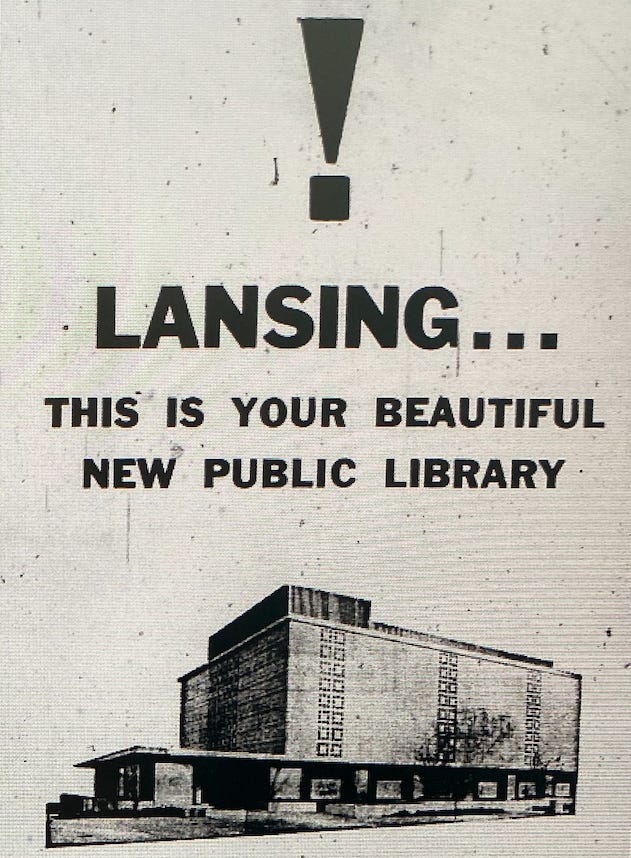
When the brand new downtown library building was dedicated on October 18, 1964, the Lansing State Journal hailed it as “an Open Door to Learning and Leisure,” an accessible community center for human re-creation.2 Before CADL took the building over in 1998, a spacious “New Beginning” classroom inside served to reintegrate students previously expelled from the public school system, including a middle schooler caught with two knives who said she was trying to protect herself from a man who threatened her at a school bus stop. “It’s more laid back,” a sixteen-year-old reported. According to press coverage, “In one case, a runaway student called the program to send a school bus for him so he could attend classes.” The program coordinator explained, “The only time he’s absent is if he’s locked up.”3
Marginalized youth in the 1990s found a place for themselves in a bustling city center at the base of a magnificent public library packed with opportunities for learning and fun. A generation later, Lansing’s most vulnerable young people, when they are not locked up, are bused out to isolated facilities in South Lansing or Mason, geographic manifestations of social marginalization. Any of these youth with an interest in artifacts of local history are invited to peruse a penurious and haphazard selection of digitized documents online. Meanwhile the better off in our new “decentralized” society can gather at the CADL Local History Center to hear veteran sportscasters reminisce on the glory days of Michigan State University basketball long, long ago. With luck, someone standing at the central bus station in downtown Lansing might be able to make the roundtrip by bus in under three hours. But remember that the last bus back to another bus to take you back to the city departs before 9:00pm, so don’t wear out your welcome.
We residents of the City of Lansing continue creating an urban life for ourselves even as our built environment is quietly pulled out from underneath us. Iconic singer-songwriter and multi-instrumentalist Jen Sygit has been hosting a longstanding, year-round, Wednesday-night open mic where a diverse range of artists have debuted innumerable songs at various local establishments over the years. Black youth from Peace & Prosperity Youth Action Movement recently appeared at a City Council meeting prepared with incisive questions. An independent, ad hoc group organized an exhibition and concert called Crashing the Capital at the Fledge on Lansing’s Eastside on February 28, 2025, using materials from Lansing’s now displaced local history collection to build intergenerational relationships between members of the nationally prominent local punk scene of the 1980s and members of the contemporary scene.
All of the participants in these and many other initiatives built by and for residents of the City of Lansing were perfectly capable of making invaluable use of Lansing’s local history collection as long as it was located in the Rosa Building, a civic center accessible by bus in under thirty minutes from almost anywhere within the city limits. Not all of them, however, have the private vehicle or driver’s license or cash in hand to exploit an Uber driver or three hours by bus to make the roundtrip to University Park & Drive in Okemos and back. Those fortunate or unfortunate enough to end up out there will find themselves in a bizarre and degraded landscape; degrading of the built environment, its ecologies, and the living things within it; dependent upon municipal services spread out across what could have been better left for wildlife and plants; isolated from green spaces such as the beautiful Reutter Park across Capitol from the Rosa Building; from the inspiring architecture of downtown Lansing such as the Capitol Building or the Boji Tower two blocks up the street; from pleasant places to gather for lunch or a cup of coffee or a drink; from the stimulating urban parade of passersby and the meditative oases intentionally built into the Rosa Building itself but already long since closed to the public.
University Park Drive is built to separate the good residents of Okemos from the urban crises of Lansing while easing the flow of frothing channels of motorized traffic and rent-seeking capital. To take your life in your hands and walk across five lanes of racing automobiles on Okemos Road to get to the nearest Applebee’s, as good a spot for lunch as anything else within walking distance of the CADL Local History Center, is to defy the social order established here in concrete and asphalt, a point profoundly appreciated by the motorists who honk their horns at pedestrians with the audacity to risk a lawful yet most iniquitous crossing. Although by comparison with Grand River in Okemos, a motorist’s paradise where a young female pedestrian was left severely impaired after a hit and run last year, Okemos Road does at least have rectangular rapid flashing beacons in case some daring sneaker-shodden genealogist gets a hankering for a signature Riblets Platter.4 A friend of mine reports that the RRFBs do nothing to diminish the terroristic honking and laments that he does not allow his children to cross Okemos Road alone, where he is aware of at least one collision involving a neighbor child on foot, with rumors of others. “We have been honked at whilst in the crosswalk with the lights on before.”5 Okemos has so effectively sealed off its resources from outsiders, not even the children of Okemos themselves can reach them on foot. But then again, where in the new society built here are the unattended children of others not treated like social undesirables?
What is at stake?
Poetic injustices abound in Greater Lansing, a sprawling, indefinite metropolitan area that sort of includes City of Lansing residents in some technical sense, at least for the purposes of Ingham County’s regressive millage system, but not in any but the most attenuated democratic sense. In the case of the concrete and drywall travesty that is the CADL Local History Center, one such injustice gnaws at me especially. When CADL expropriated Lansing’s local history collection, it packed up 90,000 mimeographed, 3x5 real estate cards, or “prospect cards,” contained in the so-called Stebbins Real Estate Collection, not fully digitized and online, rescued from a landfill by local historian Geneva Kebler Wiskemann in 1965. CADL presumably moved the cards, many of them clearly labeled “colored only” or “can be sold to colored,” straight down I-496, the local expressway notoriously built during the early 1960s upon the soil beneath the dirt below the beautiful urban houses of a thriving, middle-class, African American neighborhood.6 That neighborhood stood in the path of the military-industrial-academic complex’s bulldozers because racist redlining, effected in part through those same prospect cards, prevented it from being built somewhere else. Now the so-called progressives vie with each other to see who is the most righteously outraged over red-lining and white flight from the urban centers sixty years ago, then hop in their private vehicles for appointments with their real estate agents to find out where they can find the “good school districts.” Before the opening of the CADL Local History Center on University Park Drive, any resident of Lansing—including any of the city’s 25,000 Black residents, approximately 22% of the population—could walk or take a public bus to the Rosa Building and demand to witness the ink-soaked instruments of white-supremacist oppression for themselves. Now the evidence of the crime sits in a properly climate-controlled drawer beside I-96 in Okemos, where about 4% of the population is Black, the median income is roughly double Lansing’s, the school district is reputedly very good, and the parking is the envy of the world. CADL’s online description of the collection includes no acknowledgment of its racist history.7
Emails acquired through a Freedom of Information Act (FOIA) request filed by WKAR Public Media revealed in March, 2026, that CADL was considering a replacement, if it can even be called that, for the Rosa Building in the long abandoned Gibson’s Bookstore location across from Lansing Community College, pithily described by one internet user as a “functionally obsolete parking ramp.”8 The location, almost a full mile away from the central bus station, is approximately one fifth the size of the Rosa Building. According to journalist Andrew Roth, Executive Director Marr asserts that such a drastic reduction in size would not cause a reduction in service.9 The assertion might appear to an outside observer to be nakedly preposterous. But Marr is able to maintain with full sincerity that an 80% reduction in the size of Lansing’s downtown library building will not diminish services because the services Lansing necessarily loses in this appalling bargain do not even register for an able-bodied, affluent resident of Okemos who has spent almost her entire life cruising effortlessly about wealthy suburbs expressly built for her and people like her.
In one sense, what is at stake are not necessarily “services” per se, not in the sense of the one-way work that a class of credentialed service providers perform for passive service receivers while dutifully counting our little heads for the quarterly report. It is something more like “capacity” in the most open-ended sense. What is at stake are the meeting spaces and the pleasant places to relax or meditate; the Book Burrow, the beautiful and inspiring reading rooms, and the multipurpose rooms; the elegant, all but abandoned theater with a totally dilapidated upright piano and a stage floor that dancer and dance researcher Nic Gareiss recently recommended to me as one of the best floors for rhythmic dance in the city: “Its resonance and responsiveness are unparalleled.”10 What is at stake includes also the spaces that CADL has already closed to the public: the New Beginning classroom; an innovative and spiritually uplifting, wood-lined children’s library on the third floor, repurposed since 1998 as drywalled CADL administrative space; a breathtaking ground-floor garden kept locked up behind glass like something out of a William Blake poem; and of course the former Forest Parke Library and Archives, its pilfered treasures now displaced to University Park Drive. What is at stake is the open door to learning and leisure. Most importantly, it is whatever a diverse, democratic, and constantly evolving public chooses to do for itself with its own public library, never mind CADL’s credentialed service providers.
According to Roth, Executive Director Marr goes so far as to support a drastic reduction of Lansing’s library space by pointing out that “the current location has some space that goes unused.”11 Indeed! When we examine CADL not as a trustworthy neighbor with shared civic values but as an instrument of an elitist, overwhelmingly white, metropolitan leadership class propped up by oppressive laws and policies passed by brazenly bigoted legislatures and electorates in the 1980s and 1990s, it is no mystery why CADL has been closing the Rosa Building for the last three decades. The current president of the Greater Lansing Garden Club tells me that her organization stopped maintaining the former Japanese garden on the building’s ground floor because “people were trashing it,” assuring me that this decision was made before the establishment of CADL in 1998.12 But according to a column in the Lansing State Journal published on December 3, 1996, less than a year before the vote to establish CADL, the Garden Club was planning at that time to donate proceeds from their annual Greens Market to “the garden at the Lansing Public Library,” hardly a responsible use of philanthropic funds at a time when roving bands of urban hooligans were in the process of systematically trashing it.13 I have not been able to find any direct evidence to determine precisely when the Garden Club stopped maintaining the garden, how the decision was made, or by whom, and I have no confidence whatsoever in the recollections of anyone implicated in the decision. But what I believe I can demonstrate—what I intend to demonstrate throughout this series using the extensive press coverage of the crisis precipitating the dissolution of the Lansing Public Library in 1997—is that CADL was built as one small yet crucial piece of a broader white backlash against racial integration as advanced by the urban-based, civil-rights-oriented liberalism that built the Rosa Building in the 1960s. That for me holds infinitely more explanatory value than any alleged bands of trashy vandals.
My friends, neighbors, and family are not wrong to suggest, as they often do, that the real reason CADL wants to close the Rosa Building is that the organization doesn’t want to deal with the many visitors to the building who have almost nowhere else to go on a typical day in Lansing. Especially on rainy days, the number of such visitors, who have been a visible presence at the building at least since I was a child in the 1990s, has notably increased in the last decade, as any resident of any American city or any citizen of the world following the ongoing opioid crisis and mounting housing crisis would expect. The crises of American society, willfully concentrated in American urban centers and rural towns, are indeed raising serious difficulties for library staff who lack the support and training to address them. Such difficulties require a coordinated, cooperative community response that is simply out of the question when Lansing does not even have any real say in the administration of its own public libraries. It is not just Lansing’s most vulnerable citizens who disturb the tranquil happiness of CADL leadership out in Okemos. It is the very notion of local ownership and control over our own libraries.
Few writers ever bother to help us understand the heinous incongruity between the lively urban energy of Lansing’s residents and the annually diminishing number of open, secular, public spaces in which to gather, mingle, and weave together a civic and multicultural life befitting a modern American city. Academics have told us about “urban decline” or “post-urban America,” keywords that would like to instruct us that the dream is over, reality is out there on University Park Drive, if only we would grow up, go to graduate school—or back for more and still more graduate school—and get a mortgage.14 Or they talk about “bowling alone” and tell us that the decline in third spaces is just a matter of individual preferences, or cell phones, or social media, or anything other than something the regional leadership class has deliberately done to us with purpose and discipline, even as many of us, by the way, never stopped bowling together.15 A veritable literature has sprung up around nostalgic evocations of Lansing’s bygone industrial heyday, pining for “a time of We” before “the notion of Us vs. Them,” in the words of local poet Mary Sharp.16 An entire section in a recent collection of poetry entitled My Secret Lansing (2023) is devoted to “Time Travel,” full of cemeteries and scenes of the early automobile industry and wilderness explorers and two references to living memory I can count: recollections of the recently restored Moores Park Pool and of a long-retired auto worker born in 1937.17 Retired Lansing Community College professor Linda Peckham claims that she “can ‘see through’ to the hidden past,” to the Colonel who drowned repairing a dam, to “the woods and the mud” and the elegant old two-story Capitol Building converted into a factory in 1879, burned to the ground three years later.18 Other bits of living memory contained in the collection include a poet’s reminiscence on an occasion when he fawned over Magic Johnson in a Michigan State University (MSU) parking lot in 1979 and a reflection on watching a family house decay “as nothing, as everything, changed,” in the words of MSU professor Laura Apol.19 One might get the impression that very little of any societal significance has happened here in “Secret Lansing” in almost a century, nothing whatsoever since the current leadership class began installing itself about fifty years ago. Would that we could see through to the structure of our own historical moment. There is a grim, epochal human drama down in there that we would recognize as our own if we could grasp it.
None of these writers, poets or academics, help us understand why our own preferences never seem to count in the grand scheme of things, why everyone we meet pays into Ingham County’s regressive millage system, whether through their own or their landlord’s property taxes; everyone we meet goes out and gets involved with the Fledge, Peace and Prosperity Youth Action Movement, Jenny Sygit’s open mic, the Allen Neighborhood Center, All of the Above Hip-Hop Academy, Cedar Street Art Collective, Lansing Collage Club, Mikey 23 Foundation, REACH Studio Art Center, the Refugee Development Center, the Robin Theatre, Stoopfest, and more; and yet still there is less and less secular, open and accessible public space for us almost year by year.20 On the vanishingly rare occasion when Lansing residents have any actual say in the matter—as for example in the case of our own City Council’s embarrassingly failed proposal to sell the former Lansing City Market to a developer from Metro Detroit earlier this year—we predictably vote to preserve local ownership and control over our own secular spaces of learning and leisure.21 But as the ongoing crisis of Lansing’s public libraries illustrates, we typically have no actual say in such matters. The levers of power were displaced first. Now the community wealth follows. One of my community partners once told me that it seemed to her as if Lansing’s leaders didn’t think it was cool that we had an actual city to care for and enjoy. They seemed to think it was a nuisance. That and an asset to be carted away or sold off to a developer.
Lansing’s community wealth and CADL’s millions
The displacement of the local history collection has been but one brutally short chapter in a longer, still ongoing, remorselessly anti-Black disinvestment in Lansing. The CADL administration transparently seeks to diminish the public’s esteem for the Rosa Building, a triumph of community engagement designed through a consultative process lasting almost a decade; attentive to the smallest minutiae of the human experience, including the placement of an entrance on Kalamazoo to save pedestrians approaching from the bus station an extra half-block walk; funded primarily through a $1.9 million bond issue approved by City of Lansing voters in 1961, equivalent to about $21 million today.22 With an important part of Lansing’s former central public library abruptly sealed shut—by no means the first part of the building to be closed to the public since CADL took it over—and with $1.6 million dollars already sunk into a meretricious new facility built in CADL’s own image on its home turf beside an expressway offramp in Okemos, miles away from the nearest Lansing residence, the administration is clearly hoping that Lansing residents will be just a little more acquiescent to the closure of the Rosa Building, which the CADL administration acknowledges it was working toward for at least several years before announcing its malignant progress to a dismayed public at a City Council meeting on October 14, 2024.23
The administration’s official position is that CADL should no longer be responsible for maintaining the Rosa Building, which it leases from the Lansing School District (LSD) for a mere $10 per year, even though CADL’s responsibility for renovations was a key stipulation of the lease agreement at the time that Lansing handed its library system over to an opaque, untested, and virtually unaccountable new governmental entity in 1998. According to Executive Director Marr, “it really needs a deeper renovation, and it really is something that the Lansing School District, it would make more sense for them to do that investment.”24 Never mind that the extremely favorable agreement CADL struck with the LSD thirty years ago has allowed the organization to amass a handsome capital reserve projected to net it $400,000 in interest in 2026 alone, providing ample collateral for its $1.6 million dollar investment on University Park Drive, not to mention an impressive war chest for a scaled-down CADL administration to keep paying itself to put fresh millage proposals on sequential ballots in the very unlikely event that voters ever organize themselves to vote one down.25 The Lansing State Journal reports that Ben Shuldiner, the Harvard graduate and previous superintendent of the LSD recently decamped for his latest promotion with Seattle Public Schools, says that “the current lease was written years ago,” as if people thirty years ago were too primitive to understand precisely what they were doing when they agreed that CADL would be responsible for renovations to a building they have been invited to occupy basically for free.26
Executive Director Marr told Roth that she lost sleep at night worrying about what the steam pipes in the Rosa Building might do to the irreplaceable local history collection.27 Anyone who has worked with special collections would appreciate her concern. Local History Specialist Heidi Butler has explained the serious danger posed by high temperatures and wildly fluctuating humidity levels in the basement of the Rosa Building, the one place in the entire three-story, 75,000-square-foot structure CADL leadership was able to find for the collection in the nearly thirty years they stored it down there, no doubt losing precious sleep over it the entire time.28
But this hardly explains why a suitable space in the Rosa Building could not be found or constructed, much less why the collection had to be removed from downtown Lansing altogether. An article in The American Archivist, the journal of the Society of American Archivists, acknowledges that adapting “older structures for housing archives and manuscript collections presents challenges that tax the intellect and patience of those wishing to do so.” But it also points out that “there are several important reasons to consider reusing old buildings to make new homes for archives,” beginning first and foremost with the fact that “old buildings can be found well within the established community,” meaning that new services do not need to be extended out to undeveloped land and institutions can “take advantage of the existing infrastructure, providing a higher level of service to the archives and its employees.” Renovations of existing structures generally make more financial sense, in part because the federal government and private organizations have offered numerous grants, funds, and tax benefits to organizations willing to make such a sensible, socially and environmentally conscious use of existing community resources. “Perhaps the most compelling advantage of reuse is that renovating an old building is less expensive than new construction and includes substantial energy savings.” Reflecting upon the case of the Utah State Historical Society, which renovated the old Rio Grand Depot in downtown Salt Lake City to store its copious archival collections in 1977, the article expounds upon the aesthetic, civic, ecological, economic, moral, and sensual benefits of utilizing existing urban resources and infrastructure.29 1977 was a long time ago, however, and that is just not how we do things in twenty-first century Lansing. Although even that still does not explain why, in the worst case scenario, the collection could not have been entrusted to the Library of Michigan in downtown Lansing with its state of the art facilities, perhaps with a better Memorandum of Understanding than Lansing ever secured with CADL.
This is not even to mention CADL’s ballooning income, derived almost entirely from a regressive millage system. The LSD contributed about $1.9 million per year to the LPL’s $2.23 million annual budget for its three libraries in the 1990s, the rest made up of “state aid, grants, and penal fines,” while Ingham county, with contributions from City of Lansing taxpayers, spent only about $650,000 per year on all ten of its branch libraries.30 Both library systems were open to all: residency requirements did not begin to be implemented in the region until 1996, a feature of the retrograde transition toward regressive millage systems facilitated by new, high-tech computer systems, later by online federal databases.31 CADL today receives about $15 million each and every year from its regressive millage alone, not including state aid and interest on its capital funds, which are ample, or grant funding, which CADL evidently makes hardly a bare minimal effort to seek out, projecting a negligible $15,000 pittance in grant income this year.32 Its annual income, projected to be almost $17 million dollars in 2026, is almost triple the combined budgets of the LPL and Ingham County Libraries in 1996, adjusting for inflation. Small wonder the organization does not apparently employ a development officer and barely even bothers to apply for grant money when it is already choking on the compounding spoils of its regressive millage.
Executive Director Marr told me in 2024 that she would like to save money on the downtown library building and spend it “on books, programs, and retaining our excellent staff.” Ranked in terms of actual expenditure, the retention of a small number of CADL executives far precedes books or programs. CADL is gratuitously opaque about how it actually spends its many millions—independent journalist Steve Harry published an entire article on CADL’s generous executive compensation packages aptly entitled, “Library doesn’t answer questions.” But a FOIA request filed by Harry yielded documents showing that the total earnings of the fifteen highest-paid individuals on CADL’s payroll in 2023 amounted to almost $1.4 million, in a city with a median income of about $54,000 per year, considerably more than the $1.1 million the library plans to spend on books in 2026. Some undefined portion of this sum goes to the mushrooming cost of CADL’s executive pension packages. In January 2024, CADL’s contribution to the pension fund for top administrators leaped from 8% to 18% of total employee pay. In the year and a half since, CADL does not appear to have given any consideration whatsoever to common sense reforms, such as raising the minimum number of years required to qualify for a pension from six to ten—an approach that would make tremendous sense if the actual goal were to retain our excellent executives rather than merely to enrich them.33
As for “Outreach Projects,” CADL has budgeted a meagre $70,500 this year, of which less than $7,000 had been spent by April 30th.34 CADL did publish a “Community Engagement Report” in 2026. But its definition of community is “The Capital Area District Libraries service area,” a sprawling and highly varied geography encompassing urban, suburban, and rural areas with countless communities and radically distinct needs and interests. Residents of Lansing could be forgiven if they were completely unaware that community engagement was part of CADL’s vocabulary, much less its budget.
The details are opaque, but the trend is clear: Lansing residents today spend much more for library service than in the 1990s. What they get in return for this growing investment is a complicated matter that I will be exploring in detail throughout this series. Libraries have evolved since the 1990s, as has society, and presumably the LPL spent less on The Oregon Trail and the original Duke Nukem, most worthy investments in my experience, than CADL does on Kanopy, a streaming service I use every month but that Temple University professor Chris Cagle has incisively described as an expensive “mixed blessing.”35 My sense is that CADL is quite pleased with its stewardship of Lansing resources. But the same forces that separated Lansing’s public library system from its school system have progressively severed our libraries from the rest of our civic life. I for one would trade quite a lot of books, programs, and online resources for a revitalized central public library building. I could probably also be persuaded to bring CADL executive retirement packages more into line with industry norms. I might even be content to watch a few top administrators depart for opportunities they prefer: there is certainly no shortage of capable young people hungry for the opportunity to fill their shoes. The point is that Lansing spends more than enough for the library system it already had, and it does so on the basis of a regressive millage system whereby low-income residents contribute a much higher percentage of their annual income than any CADL leader ever has. What is at issue is how the many millions we contribute are spent.
A structural problem
There are of course, even within Lansing itself, wealthy executives who each individually make as much or more than CADL’s entire leadership team combined. Measured purely in dollars, CADL is a very small fish in a medium-sized pond crowded with leviathans, on a planet where even bigger threats hang over all our heads every single day. In my opinion, however, such a dizzying, birds-eye view of our historical moment severely distorts the underlying social reality. CADL is not at all unique in the way it operates. Part of the problem, part of what makes this comparatively small organization worthy of close critical scrutiny, is that it is absolutely typical. The decisions it makes concerning Lansing are repeated with variations throughout Greater Lansing and across the entire country, with compounding effects. Part of my challenge in this project is to get us thinking about CADL both as a medium-sized, regional institution—albeit one of the largest library systems in the State of Michigan—and also as embedded in a broader restructuring of twenty-first-century American society.
I know some of CADL’s leaders well enough that we greet each other by name and members of my family can recognize them from a distance. I’ve worked with them in various capacities and had pleasant conversations with them. Personally, I like them. They have a groovy vibe. I have known them to be very good at their jobs, and I’m sure they treat their families and their neighbors well. I’d be thrilled to buy any of them a cup of coffee, and I wish they would tell me what they actually think as individuals about the current crisis of libraries in Lansing, because I really don’t know. I know from extensive personal experience that all of them work very hard to maintain at least some vestige of a functioning library system in my city. From speaking with them and working with them, I am confident that they share with me the desire to see libraries function as community spaces where diverse people can learn, grow, work, relax, have fun, struggle to pursue their dreams, and be uplifted in their lives. I assume that all of them got into this work at least in part because they saw that libraries can function in all of these ways. They are all perfectly capable professionals, so if they were in it for the money and the power, they could all find much easier and more efficient ways to get it. I can only conclude that they do what they do because they want to make the world a better place through libraries. My life would be worse if there was no public library in Lansing. But I still think we should all be more than willing to wager what we have for something we can’t yet foresee. We can do better. I believe we have an obligation to do better.
The problem is less the particular individuals who run CADL than it is the institution itself. Legally speaking, CADL is a governmental entity established under the State of Michigan’s 1989 District Library Law. But its Board of Trustees is unelected, and although the City of Lansing is by far the largest contributor to CADL, only two of the board’s seven members are appointed by City of Lansing leaders, who have in any case demonstrated a remarkable complicity with CADL’s institutional agenda from the very beginning. The ballot proposal for the first CADL millage, drafted with miraculous alacrity, passed with exceptionally low voter turnout, locking Lansing residents into what was effectively a permanent arrangement with virtually no direct voter influence on its future.36 Voter apathy or a lack of civic engagement were not to blame, however. Local leaders understood and openly discussed the threat to local control posed by a district library model. School board member Gary Ferris warned that folding the Lansing Public Library into a broader system would leave Lansing exposed to marginalization and dispossession. “I don’t want to turn it [the library] over to another entity that would be liable to look to the Lansing library for budget cuts,” as the LSD itself just had.37 Meridian Township, where Okemos and Haslett are located, had itself proposed a township-controlled library system of its own with an appointed supervisory board in 1997. “More local control,” explained Township Manager Gerald Richards.38 But Meridian Township voted down the proposal, and Lansing Public Library board chairman Robert McConnell openly courted residents of “the out-county areas,” pointing out that Lansing Public Library held enviable assets that could be redistributed out of the city for a mere 1 mill, equivalent to approximately a $40 annual tax burden on an $80,000 house.39 Loss of local control was a feature, not a bug. Special carveouts in the district library law for wealthy and established areas such as East Lansing—a completely separate municipality bordering the City of Lansing—together with the organization and class-consciousness of the East Lansing leadership class, allowed East Lansing to opt out of the poisonous arrangement altogether. To this day it maintains its own public library system. Less organized yet still very wealthy and class-conscious residents of Okemos eventually came around to the realization that the 1989 District Library Law was deliberately designed to support their interests at everyone else’s expense. Defeating the district library proposal would have required a truly impossible level of organized and unified opposition within Lansing, even if city and community leaders within Lansing did not already identify with the affluent, “out-county” bourgeoisie more than with their own neighbors in Lansing. By 1997, the game was already rigged.
Personality, passion, competence, lived experience, and material interest play an outsized role in a situation where an extremely small number of unelected individuals can make unilateral decisions affecting the public library access of more than two hundred thousand people in Ingham County. I have no doubt that CADL’s leaders would do a better job in Lansing if more of them lived in the city; if collectively they had more personal experience with contemporary urban life; if each of them knew and loved someone who relies upon public transit; or if more of them had ever witnessed for themselves what ordinary residents of Lansing are capable of doing for ourselves and our communities with an accessible local history collection—to my knowledge, no one from the CADL Board of Trustees or leadership team attended Crashing the Capital at the Fledge. A public library system based in Lansing would no doubt be more invested in Lansing and better able to recruit leaders equipped to serve its residents. But that is the the fundamental problem: an institution based in Okemos, not the particular group of individuals who happen to run it. CADL was built on foundations, material and political, laid over decades at every level of society, including the federal, state, and local. Lansing residents who desire an urban library system need to be thinking and acting at all of these levels all at once. The solution to the present crisis is to build up the foundations for a completely different sort of library system, one more integrated into our communities and responsive to our needs.
Some cynic might tell us that this is all vanity because we are all about to be washed away in the coming deluge: environmental collapse, AI apocalypse, global pandemic, nuclear holocaust, all of the above. It is a comforting thought for a people who don’t want to take responsibility for themselves. But consider the more frightening possibility that the world is not about to end, that the choices we are making today right here in Lansing and Greater Lansing are in fact building a new society, if not a new sort of civilization, more robust and far more oppressive and morally stupid than we are yet prepared to imagine. Go to University Park Drive, if you are able, and tell me: what does this possible future look like to you? Is this where you want to live? Is this what you would wish for the children in your life? And if this really is what you desire, have the honesty to tell the rest us: whom do you think should be excluded from this moonscape built by and for exclusion?
Now get as close as you can to the ground floor garden of the Rosa Building. No matter who you are, if you live anywhere in Lansing, you can get right up next to it without difficulty. Peer at it through the sealed glass as if it were an empty diorama in an abandoned museum of the 1960s and ask yourself: why do you tolerate being cut off from such a beautiful space? Why do we as a community tolerate this situation? What incalculable waste are we attaching to our own souls each and every day that we allow ourselves to live like this? How will future generations regard what we have done here, done to each other, done to them? Because while it is true that we woke up this morning without the democratic mechanisms to make our libraries serve our needs, interests, and purposes, none of us has any excuse to settle for such a status quo any longer.
A CADL employee advised me earlier this year that if I would like to keep my downtown library building, I should give CADL a break and talk to my City Council about coming up with the money for renovations.40 The rational kernel within this advice is that Lansing residents need to look to each other to rescue what they already have and to build it up into something better, presumably into something radically different from anything preceding it. But it would be sheer folly for us to attempt to resolve the present crisis by handing over still more capital, liquid or fixed, to an opaque and unaccountable institution based infinitely more in Okemos than in Lansing. Any resource CADL can get its hands on it will eventually use to deepen and widen the moat separating wealthy Okemos from exploited Lansing, pumping more taxpayer dollars into executive pensions, shutting down facilities and terminating programs in Lansing, purchasing and furnishing new properties in Okemos, or doing whatever else CADL’s all-white, unelected, unaccountable leadership decides to do with our money and our resources. CADL understands the assignment even if Lansing residents with their rainbow-colored “I love my library!” yard signs do not. We the residents of Lansing need to lay the foundations for a new Lansing Public Library to replace CADL and to reclaim our community wealth and tax dollars for ourselves.
A matter of first principles
The issue of course is not that CADL never faces any real crises. It does, more and more so every year. The issue is that CADL gets to decide unilaterally how to resolve these crises. In general, it heads out to Okemos where it can avoid them for at least a little while longer rather than face them directly in Lansing in consultation and cooperation with Lansing residents. Lansing’s own incalculable interest in maintaining its own local history collection and its own central downtown public library building does not apparently count for very much with CADL: or rather, we don’t know what it counts for because CADL has not released so much as an estimate for the undefined “deeper” renovation it proposes—I have asked them for one and they have not replied to me.41 We don’t know how it would compare to the $1.6 million the organization just invested in its own asset on University Park Drive in wealthy Okemos. Is it too much for me to assume that it would be a bad look for CADL if we did?
The one thing we know for certain is that CADL now intends to unilaterally redefine the terms of its 1998 agreement with the LSD: CADL is responsible for renovation, but not “deeper” renovation. Yet the characterization of such a manufactured crisis as a matter of public finances relies almost entirely upon the extreme credulity and complacency of a public with a habit of assuming that local and regional leaders only do what they have to do, that every fresh degradation of our built environment and civic life is driven by the iron law of historical necessity or—to say much the same thing in a more contemporary way—perpetrated by shadowy billionaires or caused by the advent of the smartphone or COVID or Donald Trump or the DNC establishment or climate change or processed foods or whatever impersonal, faraway, unassailable enemy we can name rather than confront the fact that Americans across the country face a new sort of highly mobile leadership class with precious little connection to, knowledge of, or respect for the people and the places they govern, and without the same sense of moral duty once felt by urban-based, civil-rights-era liberals, for all of their own shortcomings. CADL is making free and voluntary decisions, predictable decisions perfectly in line with a definite historical pattern, on the basis of its own established institutional structure, values, and priorities, in the service of a peculiar sort of metropolitan elite untethered from democratic accountability.
I believe it is a mistake, arguably one of the characteristic ideological mistakes of our time, to imagine that we can separate the big, apocalyptic issues of today from the quotidian, small-scale exploitation we face at the hands of this new, quasi-placeless petit élite, at home everywhere and at home nowhere, ping-ponging about the country in pursuit of fresh promotions, better restaurants, good school districts, and the perfect parking spot, demolishing old buildings and replacing them with shoddy, disposable new constructions out on previously undeveloped swampland, boasting about it in cover letters for their latest job application. The very forces that laid the groundwork for CADL were at the same time busting unions, redistributing wealth away from racially integrated urban schools, and making cosy with a milquetoast Democratic-Leadership-Council-style DNC or, worse, getting ready to stop worrying and love MAGA Republicanism. The laws, policies, and institutions they established in the 1980s and 1990s continue to do their sinister work today.
We don’t know for certain what happens to American liberalism when there are no longer any central urban public libraries. But we can hazard more than a wild guess. Already we know from research on the rising “multiracial political right” that the continuous economic catastrophe that has characterized almost the entire first quarter of the twenty-first-century, with particularly deleterious and concentrated effects upon Black and minority Americans, has driven many Black and minority voters to decide that the Democratic Party is useless at best, the enemy at worst.42 Whatever temporary reprieve the DNC may enjoy in the upcoming midterms courtesy of the satanic stupidity of the Trump administration, I see no reason to believe it will last. Civil-rights-era liberalism was premised upon the idea that human dignity demanded certain civic and material foundations so basic that they needed to be permanently guaranteed to everyone, no matter their past or present circumstances, and no matter current economic conditions—which for CADL, by the way, are exceedingly rosy at the moment. Among those basic foundations were urban public libraries, by which I mean multifaceted, multipurpose, awe-inspiring, secular institutions thickly embedded in civic life, accountable to the public, and suited to numerous and sometimes unforeseeable uses, not just tightly regulated little suburban branches where you can go pick up your holds and maybe catch an early story time before hurrying home to your lightning-fast WiFi and state-of-the-art entertainment center in Okemos. The variety of suburban progressivism that is making Lansing look more like a suburb of nowhere is making America look more like Trump country. If we don’t even owe one another an urban public library adequate to a city of 110,000 residents, what do we owe one another?
Notwithstanding academic prophecies of “urban decline” and “the rise of post-urban America,” contrary to the academic assertion that America somehow “became suburban” many decades ago, tens of millions of Americans still live in hundreds of medium-to-large-sized cities all across the United States, with new immigrants arriving every day, even with the Trump administration’s retrograde immigration policies and monstrous enforcement measures.43 The processes of capitalist exploitation and racist oppression that have built up metropolitan empires such as Greater Lansing also necessitate urban centers such as the City of Lansing. International refugees are routinely placed in medium-sized cities, where strained governmental services and non-profits still furnish as supportive an environment as can be found anywhere else in the contemporary United States for individuals and families who are trying to build a happy life for themselves without the benefit of independent wealth or a professional-class income. The bourgeois center still needs its exploited periphery to work its diabolical magic, even as it seeks to remake that periphery in its own stunted image. We in the urban periphery are up against a leadership class centered and sheltered in places like Okemos. The Rosa Building—not just a downtown library branch, but the one and only Rosa Building standing at the corner of Capitol and Kalamazoo in Lansing, Michigan, USA—should be an absolute non-negotiable.
Executive Director Marr, who grew up in wealthy East Lansing, likes to point out that the displacement of the local history collection and the closure of the Rosa Building each started as an initiative long predating her arrival to wealthy Okemos two years ago from wealthy Metro Detroit, as if CADL’s current plans had been handed down by a luminous, prehistorical council of sturdy and unimpeachable elders. “I’m coming in at the end of this process and have been tasked with getting this project over the finish line,” she told me when I objected to the proposed closure of the building in 2024.44 “We’ve been thinking about it for years,” she said of the displacement of the local history collection this year, although I am unaware of any public record of their early deliberations. “It’s been a kind of a dream for a long time.”45 We are long overdue for a critical interrogation of these longstanding dreams and their social origins.
“I think we’re all looking to accomplish the same things here,” says Executive Director Marr, a most convenient assertion for the woman who gets to decide not just what we want but what we get.46 About that there is nothing but diametric opposition. Either CADL will return Lansing’s local history collection to Lansing, or it will not. Either Lansing will retain a magnificent central public library building accessible by public transit to all residents of Lansing—not just a pitiful substitute “downtown branch” technically on a bus line somewhere—or it will not.
The conflict between CADL and Lansing residents does not boil down to a surface-level disagreement about how best to accomplish the things we all want. There is in fact no underlying agreement about what we want, what we are obligated to want as responsible citizens of the free and democratic society each of us is supposed to help build and preserve. Executive Director Marr would like you to believe that we are all like-minded people doing our best to manage aging infrastructure and limited resources. In fact we are engaged in a civilizational struggle between fundamentally irreconcilable beliefs and first principles, a conflict that was already raging in the mid-1990s, when CADL was first established. Which side are you on?
Introduction to this series
I have decided to publish this project in a series of installments for two main reasons. First, the topic involves conflicts and trends at multiple levels of society over a period of roughly four decades, necessitating a much longer treatment than a typical magazine article would allow. Although CADL’s victim/host is Lansing, and the legal mechanisms involved are somewhat unique to the State of Michigan, the complex story I will be telling here amounts to just one small thread, albeit a particularly illuminating one, in a broader contemporary conflict. The story of the thirty-year crisis of Lansing’s library system warrants a thorough critical treatment. To my knowledge, no such treatment has previously been written. This project attempts to help fill the gap.
Second, an installment series is necessary because the matter at hand is urgent and current. Every evening I write or research this project, and every morning before I leave for my day job I look to see whether CADL has officially announced the closure of the Rosa Building, as I expect it will almost any day now. We need serious critical coverage of this issue right now, while it might still be expected to make some sort of difference, if only to help us process a social and civic catastrophe far worse even than last year’s cruel demolition of the old Eastern High School and farcically botched $14.1 million Michigan Avenue facelift based upon a glib and ultimately disregarded community consultation, comparable in some respects to the abortion of a proposed CATA Bus Rapid Transit line to connect downtown Lansing and Okemos following objections from business owners in 2017.47 Executive Director Marr has a history of telling people that she doesn’t know anything yet and trickling out curated nuggets of information as a negotiating ploy or when confronted with a FOIA request.48 In 2024 she told me, “it’ll take as long as needed to find the right fit for library services in this area.”49 But CADL and Jenny Marr of Okemos, not Lansing residents, will decide when that right fit is achieved. And when the right fit for Lansing’s local history collection was found ten miles away in Okemos earlier this year, the board took its vote with machine-like efficiency, the moving vans quietly came and went, and months later, Lansing residents I speak to still tell me I’m the first person to tell them about it. An installment series is my best effort to get just a little bit in front of things, even at the risk of getting ahead of myself.
My plan at this time is to deliver this series in five remaining installments, examining decades-old conflicts over the Rosa Building between urban-based liberals and their opponents, policy and technological changes of the 1980s and 1990s that made CADL possible and perversely inevitable, local and regional conflicts over the establishment of CADL in 1996 and 1997, swift and radical changes to library service in Lansing beginning immediately in 1998, and conflicts between metropolitan elites and residents of Lansing and other American cities today. My argument throughout this project is not that the present crisis of the Rosa Building is a mere repetition of past history. It is that we are witnessing only the latest episode in a single, malevolent class project with anti-Black racial dimensions pulling inexorably in one and only one direction, advanced at every level of governance from the federal to the local, stretching in an unbroken arch from the “anti-tax,” anti-integrationist, patently racist movements of the 1970s to our own degraded present and onward to a most lamentable future out on University Park Drive in Okemos.
But it is also that the liberal spirit expressed in the design, construction, maintenance, and promotion of the Rosa Building is not dead, although it is impossible to overstate the gravity of its present crisis. For now at least, the people I meet through the Allen Neighborhood Center, All of the Above, Cedar Street Art Collective, the Fledge, Jenny Sygit’s open mic, Lansing Collage Club, Mikey 23 Foundation, Peace and Prosperity Youth Action Movement, REACH Studio Art Center, the Refugee Development Center, the Robin Theatre, Stoopfest, and other local initiatives demonstrate through their actions that they still believe in the supposedly outdated dream of the city, the notion that urban centers provide the one place in modern American society where people of all sorts are obligated in both moral and practical terms to live side-by-side, at least to some minimal extent, learning from one another and supporting one another as we attempt to forge a more perfect union. This series explores this side of so-called urban decline as well, connecting the struggles of city residents today to those of urban-based, civil-rights-oriented movements for racial integration and social justice. History with a capital “H” may belong to the victors out on University Park Drive, but a future worth living for belongs to us.
Community leaders with whom I have spoken have assured me that they unanimously oppose the closure of the Rosa Building, which they are powerless to prevent. They offer many cogent reasons for their opposition, including some that had not occurred to me and that I look forward to exploring throughout this project. But I do not get the impression that there is a general, shared understanding of what CADL actually is in an institutional sense; how radically it differs from the former Lansing Public Library, whose unwanted and discardable shell it temporarily wears; how opaque and detached from democratic mechanisms it is by design; how it is governed, by whom, and in whose interests; how it was prepared by new state laws passed in the 1980s and 1990s; or what purposes it serves for an established leadership class in both Greater Lansing and Lansing proper. Someone once observed that people need to be conscious of a conflict before they can fight it out. This project seeks to promote such consciousness.50
Susan Vela, “Preserving Local History,” Lansing State Journal, May 19, 2026. I speak in this essay as an individual resident of Lansing. Although I speak of collective experiences, I do not speak for anyone but myself. My references to local organizations are not meant to imply that these organizations know about or endorse this project. In my view, these organizations demonstrate the strength, creativity, and tenacity of Lansing residents, whether or not their participants or leaders agree with the views expressed in this project, which are my own. My hope is that this project can help Lansing residents organize themselves to build a library system that will serve them.
“Lansing’s New Public Library, an Open Door to Learning and Leisure,” Lansing State Journal, October 18, 1964.
Mark Andrejevic, “Expelled Students Ready to Return,” Lansing State Journal, January 25, 1996.
Shajaka Shelton, “Police call for information after hit-and-run in Okemos,” WLNS.com, April 1, 2025. Ken Palmer, “East Lansing man charge in Meridian Township hit and run crash,” Lansing State Journal, June 13, 2025.
David Biedenbender, text message to the author, October 4, 2026.
They Even Took the Dirt (2023), a documentary of Pave the Way: The I-496 Project, https://www.lansinghistory.org/they-even-took-the-dirt (accessed September 4, 2026).
“House History Research,” https://www.cadl.org/research-learn/local-history/person-research/researching-history-your-home (accessed October 4, 2026).
Andrew Roth, “CADL exploring former Gibson’s Bookstore space for downtown Lansing branch,” WKAR Public Media, March 16, 2026.
Roth, “Gibson’s.”
Nic Gareiss, text message to the author, September 28, 2026.
Roth, “Gibson’s.”
Telephone conversation with the author, August 31, 2026.
Karen Douglas, “People Etc.,” Lansing State Journal, December 3, 1996.
Robert A. Beauregard, Voices of Decline: The Postwar Fate of U.S. Cities (Routledge, 2003); Robert A. Beauregard, When America Became Suburban (University of Minnesota Press, 2006); Jon C. Teaford, The Metropolitan Revolution: The Rise of Post-Urban America (Purdue University Press, 2006); Katharine Bradbury, Anthony Downs, and Kenneth Small, Urban Decline and the Future of American Cities (Bloomsbury Publishing, 2011).
Robert D. Putnam, Bowling Alone: The Collapse and Revival of American Community (New York: Simon and Schuster, 2000).
Ruelaine Stokes and Laura Apol, ed., My Secret Lansing (Lansing Poetry Club, 2023), 24.
Stokes and Apol, My Secret Lansing, 13–24.
Stokes and Apol, My Secret Lansing, 15.
Stokes and Apol, Secret Lansing, 46, 55.
In the interest of full disclosure, my current day job is with the Allen Neighborhood Center, an organization that I believe to be a powerful force for good in my neighborhood and an illustrative example of an initiative built by and for Lansing residents. This Substack series is, however, my own independent work and in no way endorsed or supported by the Allen Neighborhood Center as such.
“Voters reject the sale of the Lansing Shuffle property,” WKAR Public Media, August 5, 2026.
Jo Anne Jager, “Darling’s legacy lives on,” Lansing State Journal, August 11, 1996. Robert Stuart, “New Library Will Be Dedicated Today,” Lansing State Journal, October 18, 1964. “Easy Access For Public Big Factor,” Lansing State Journal, October 18, 1964.
Mike Ellis, “Lansing City Council opposes CADL’s potential move from downtown branch,” Lansing State Journal, October 14, 2024. Alana Lundgaard, “Lansing City Council Stands Firm: Opposition Grows Against Move of Downtown Library,” Spartan Newsroom, November 13, 2024. “My predecessor [Scott Duimstra, now the Library Director of the Hennepin County Library in Minneapolis,] worked on addressing this challenge with the board as well, and had done a lot of the groundwork in exploring a path out of this building.” Jenny Marr, email to the author, November 1, 2024.
Roth, “Gibson’s.”
Capital Area District Libraries Board Meeting Packet, May 27, 2026, 30.
Ellis, “Council opposes.”
Roth, “Gibson’s.”
Vela, “Local History.”
Jay Haymond, “Adaptive Reuse of Old Building for Archives,” The American Archivist 45, no. 1 (Winter 1982), 11–13.
Mark Andrejevic, “Lansing library’s fate still in limbo,” Lansing State Journal, April 12, 1996. Louise Knott, “Ingham Voters to Decide on Library,” Lansing State Journal, July 30, 1997.
Faith Johnson, “East Lansing library gets a new computer,” Lansing State Journal, April 12, 1996. “Library fees: One answer to shortfall,” Lansing State Journal, July 2, 1996.
Capital Area District Libraries Board Meeting Packet, May 27, 2026, 30.
Steve Harry, “Taxpayers bail out underfunded CADL pension fund,” SteveHarryPublicPolicy.com, January 7, 2024. Steve Harry, “Library doesn’t answer questions,” SteveHarryPublicPolicy.com, June 8, 2024.
Capital Area District Libraries Board Meeting Packet, May 27, 2026, 30–32.
Chris Cagle, “Kanopy: Not Just Like Netflix, and Not Free,” Film Quarterly, May 3, 2019.
Margarita Bauzer, “Low turnout expected in today’s election,” Lansing State Journal, August 5, 1997.
Mark Andrejevic, “1-month deadline set to save library,” Lansing State Journal, May 18, 1996.
Louise Knott, “Ingham Voters to Decide on Library,” Lansing State Journal, July 30, 1997.
Knott, “Ingham Voters.”
Conversation with the author, August 20, 2026.
In an email on September 22nd and in hardcopy at a CADL Board of Trustees meeting on September 23rd, I posed four questions. I believe the answers would be of immense public interest. CADL leadership has not responded to any of them. First, what alternatives to the closure of the Forest Parke Library and Archives and the relocation of Lansing’s local history collection to Okemos did CADL leadership consider before deciding to proceed with the Okemos location? What were the estimated costs of those alternatives? Second, Executive Director Marr said that the Rosa building needs a “deeper” renovation and that “it would make more sense” for the Lansing School District to make that investment. What specifically would that “deeper” renovation entail, and what is the estimated cost? Third, CADL administers a library system that encompasses urban, suburban, and rural communities with very different needs. What does CADL consider an equitable distribution of resources across this diverse geography, and how does it assess whether it is meeting that standard? Fourth, what research has the CADL administration and Board of Trustees conducted to project Lansing’s library needs for the next 5–10 years, including with respect to new housing projects and planned downtown revitalization? What are the findings of this research?
Daniel Martinez HoSang, “Inside the Rise of the Multiracial Right,” New York Times, July 24, 2025.
Beauregard, Voices of Decline; Beauregard, Became Suburban; Teaford, Metropolitan Revolution; Bradbury, et al, Urban Decline.
Jenny Marr, email to the author, November 1, 2024.
Vela, “Local History.”
Lundgaard, “Opposition Grows.”
Duncan Phenix, “Demolition of old Eastern High School in Lansing begins,” WLNS.com, March 4, 2025. Daylyn Huff, “Michigan Avenue in Lansing reopens after $14.1 million dollar project,” WLNS.com, October 17, 2025. Beth LeBlanc, “CATA board shelves plans for BRT,” Lansing State Journal, April 19, 2017.
Roth, “Gibson’s.”
Jenny Marr, email to the author, November 1, 2024.
Capital Area District Libraries and the CADL Board of Trustees did not respond to requests for comment on this article presented by email on September 22nd and in hardcopy at the CADL Board of Trustees meeting on September 23rd. Thank you to my family for letting me rant about CADL for the last few months. I’m not finished yet, but you can expect to hear new material in the coming months—just wait until you hear about Beulah Bock! Thank you to Steve Harry for fighting the good fight, sharing his knowledge, and offering his encouragement. Thank you to Morris Arvoy, Elise Bonner, Valentina Denzel, Lindsey Eckenroth, and Heather Hollerith for their insightful feedback on earlier versions of this article. Whether or not they agree with my conclusions, they engaged deeply with my argument and helped to strengthen it.
I've shared this on r/lansing and r/MichiganStacks on Reddit. Maybe that will get you some more views, but I fear that many who might be interested in this topic will be put off by the way you present this material. Nobody wants to wade through 43 minutes of this, especially not if it's only the first installment of a series. This piece needs editing.
Excellent first piece, even if a bit long.
In circumstances like the CADL Local History Center, it reminds me of this quote from Chapter 15 of the revised edition of Jarrett Walker's Human Transit
"If an employer, government, or organization reduces real estate costs by locating in a hard-to-reach place, they may have saved money for themselves, but they've increased costs for their employees and visitors."